Armenian Wedding Traditions: What to Keep and What to Simplify
An Armenian wedding is built from rituals that are anywhere from a hundred to three hundred years old, and deciding which ones matter to your particular couple is a task of its own. Some traditions are load-bearing — without them, the celebration loses its identity. Others have quietly become a checkbox on the schedule, performed because "that's how it's done" rather than because they mean anything, and nobody will miss them if they're gone. Here's a look at the most visible ones, one by one.
The bride's "abduction" and the ransom
Technically these are two separate customs, but modern weddings usually fold them into one scene: the groom's friends "take" the bride away, and he has to complete a few playful challenges or pay a symbolic ransom to her family to get her back.
The abduction's historical roots are serious — there were times when it wasn't theater at all, but a real way to marry against a family's wishes. Today it's pure play, and that's exactly why it works: guests get entertainment early in the day, the groom gets material for friendly teasing, and the photographer gets genuine, unscripted shots.
Worth keeping if there's a tamada or MC in the group who knows how to keep the pace — without someone moderating, the ransom scene easily drags on and turns into an awkward lull before guests have even settled in. If there's no one to run it well, trim it down to five minutes of symbolic jokes rather than stretching it to half an hour.
Breaking a plate
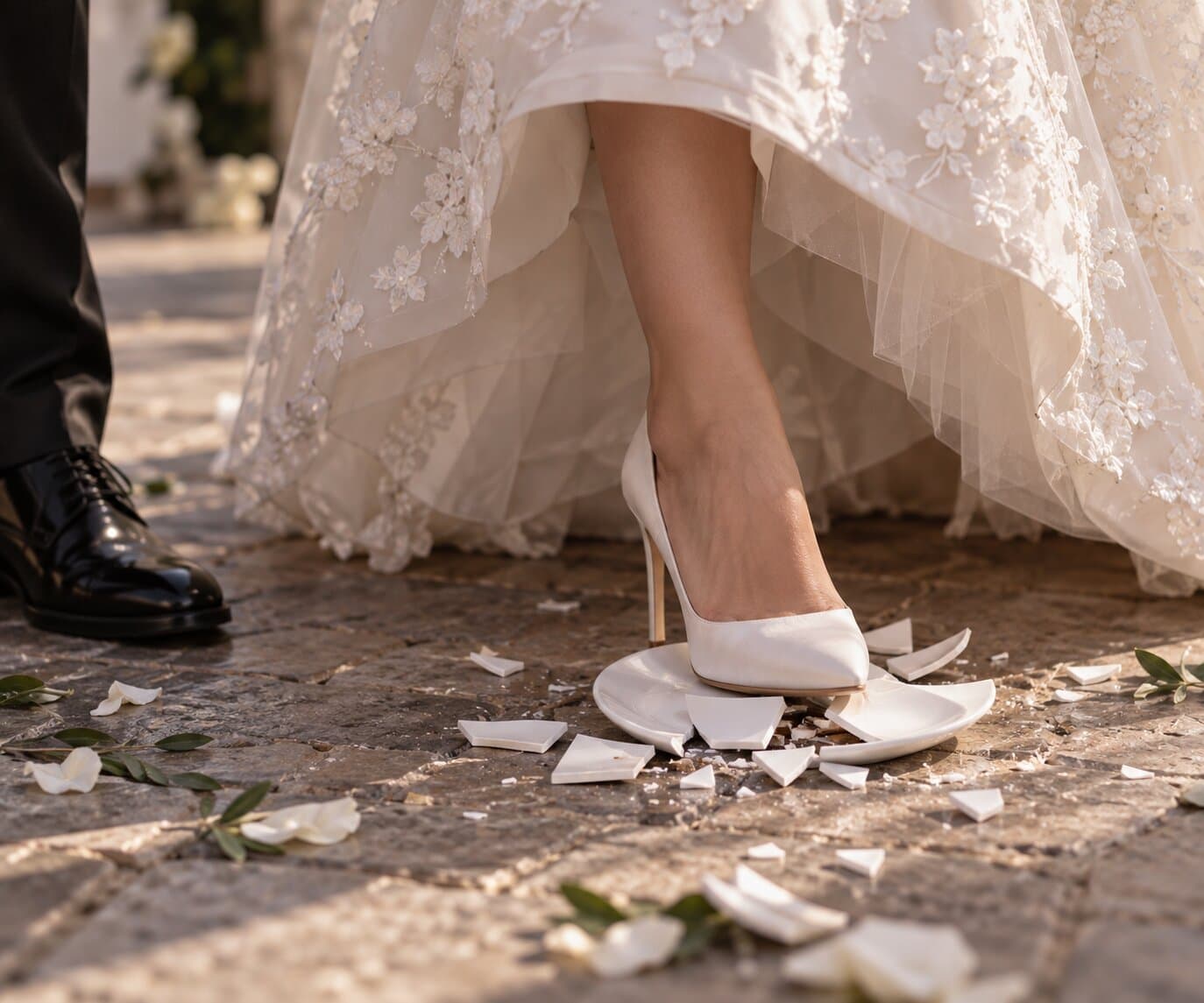
A plate (or a glass) is broken at the threshold of the bride's or groom's home — for luck, and to mark the shattering of the old life that's ending. The ritual is short, striking, and requires zero preparation beyond a plate nobody will miss.
Absolutely worth keeping. It's one of the rare moments that takes thirty seconds, costs nothing, and still delivers a strong visual — photographers and videographers routinely name it among their favorite shots of the day.
The sword dance
A sword dancer greets the wedding procession or opens the dancing part of the evening — loud, dramatic, and almost always one of the standout moments in the wedding video.
It's a relatively recent addition compared to the church ceremony or breaking the plate, and it doesn't rest on deep symbolism so much as on the energy it sets for the evening. Worth keeping if the family likes a big, loud start to the banquet and the budget allows for a professional performer rather than a relative's improvised version — the difference in quality is obvious right away.
The elders' blessing
Parents and older relatives bless the couple — with words, with bread dipped in honey and salt, sometimes with money thrown at the couple's feet. This is one of the most important moments of the day in terms of meaning, not spectacle.
This one should always stay, even if the couple decides to simplify everything else on the program. The blessing is, essentially, the reason the older generation of the family comes to the wedding at all — for grandparents and parents, it isn't a formality, it's the emotional peak of the day. Dropping it is the one decision on this whole list that can genuinely hurt feelings.
What has actually become formality
Part of the traditional program has, over recent decades, turned into an automatic scripted item performed because "everyone does it," not because it means anything to this particular couple.
This often includes the old-style gift and cash announcement, where each guest is named aloud along with the value of their gift — a procedure that, at a 350-guest wedding, can eat up more than an hour and exhaust everyone, including the newlyweds. More and more couples are replacing it with a short collective thank-you, or skipping the public part entirely and leaving gifts on a separate table.
The same goes for a long, strictly hierarchical toast list — one from every relative, in order. A good tamada can keep this moment lively, but if there's no tamada and only an MC, it's worth agreeing on a toast limit and order in advance, or the dinner turns into a marathon.
How to decide what stays
There's no universal answer, but there's a working principle: keep the rituals that matter to the older generation and carry real meaning, and trim the ones that have become length for its own sake. Breaking the plate and the elders' blessing are almost always worth the five minutes. The ransom scene and the sword dance are worth keeping wherever someone can run them well. The long procedural stretches of the program are the first thing you can safely cut if the evening is already running past midnight.
It's worth going over the ritual list with your tamada ahead of time — a good host has seen dozens of Armenian weddings and knows exactly which moments hold guests' attention and which can be shortened without costing the evening its atmosphere.
Find a vendor: Tamadas and hosts · Entertainment